

7 Seasonal Mushroom Varieties Chefs Should Cook
Last Updated: October 30, 2026
Quick Summary
Seasonal mushroom varieties for chefs follow a calendar: maitake, matsutake and lobster mushrooms peak in fall, chestnut mushrooms run October through March, and oyster, king trumpet, shiitake and lion's mane are farmed year-round. Build a farmed base menu and rotate wild varieties as limited features.
- Matsutake and lobster mushrooms are wild only, with shelf lives of 3-5 and 3-4 days.
- Store fresh mushrooms in a paper bag in the refrigerator, never sealed plastic.
- Keep one farmed substitute ready for every wild variety on your menu.
- Order delicate oysters and lion's mane in smaller, more frequent deliveries.
- Blanch and freeze surplus wild mushrooms for soups or braises.
Table of Contents
- Why Seasonal Mushroom Varieties Change Your Menu
- The Mushroom Seasonality Guide: What Peaks When
- 1. Maitake: The Fall Centerpiece
- 2. Matsutake and Lobster Mushrooms: Short Wild Windows
- 3. Oyster Mushroom Varieties: The Year-Round Workhorse
- 4. King Trumpet, Shiitake, and Chestnut: The Best Mushrooms for Cooking
- How to Store Fresh Mushrooms Through a Service Week
- Building a Seasonal Menu with Mushroom Direct
- Frequently Asked Questions
Why Seasonal Mushroom Varieties Change Your Menu
Seasonal mushroom varieties are the fastest way to signal that a kitchen cooks with the calendar, not just the catalog. Mastering the nuances of local ingredient sourcing elevates these transient flavors into a cohesive narrative that defines the regional identity of Carmel cooking.
Farmed mushrooms are available year-round, but "available" and "at their best" differ. Wild foraged windows are short and unforgiving; farmed crops are steady but still respond to temperature and humidity. Building a menu that respects both is the whole game.
Below, we break down seven seasonal mushroom varieties for chefs, when each peaks, and how to cook and store them without wasting product.
The Mushroom Seasonality Guide: What Peaks When
A mushroom seasonality guide for chefs is a working calendar telling you what to feature, substitute, and expect to pay each month. Wild mushrooms follow weather; cultivated mushrooms follow the grower's climate control.
Use this as your starting framework, then layer in your own supplier's harvest reports:
| Variety | Peak Window | Source | Best Cooking Method | Typical Shelf Life |
|---|---|---|---|---|
| Maitake | Fall (September-November) | Farmed and wild | Roast, sear, grill | 5-7 days |
| Matsutake | Fall (September-November) | Wild only | Grill, clear broth | 3-5 days |
| Lobster | Late summer to early fall (August-October) | Wild only | Sauté, pasta, risotto | 3-4 days |
| Oyster varieties | Year-round, best in cooler months | Farmed | Sauté, roast, fry | 4-6 days |
| King Trumpet | Year-round | Farmed | Sear, grill, roast | 7-10 days |
| Shiitake | Year-round | Farmed | Pan-sear, stir-fry, broth | 7-10 days |
| Chestnut | Cooler months (October-March) | Farmed | Roast, sauté, braise | 5-7 days |
| Lion's mane | Fall through spring | Farmed | Sear, roast, shred for "crab" | 5-7 days |
A Region-Aware Seasonal Calendar
Most guides treat "seasonal" as one national window. In practice, the same mushroom peaks weeks apart by latitude, elevation, and coastal versus inland weather. The table below is a planning framework, not a guarantee, confirm against your supplier's weekly harvest notes.
| Variety | Pacific Northwest | Upper Midwest | Northeast | Southeast |
|---|---|---|---|---|
| Maitake (wild) | Sep-Nov | Sep-Oct | Sep-Oct | Oct-Nov |
| Matsutake (wild) | Sep-Nov | Sep-Oct | Sep-Oct | Rare |
| Lobster (wild) | Aug-Oct | Aug-Sep | Aug-Sep | Sep-Oct |
| Oyster (farmed) | Year-round | Year-round | Year-round | Year-round, slower in summer |
| Shiitake (farmed) | Year-round | Year-round | Year-round | Year-round |
| Lion's mane (farmed) | Year-round, best fall-spring | Year-round, best fall-spring | Year-round, best fall-spring | Year-round, best fall-spring |
Two practical takeaways from the regional view:
- Wild windows shift, farmed supply does not. If your menu depends on wild maitake or matsutake, build the feature to open and close on your region's window, not a national one. A Northeast kitchen may run matsutake a week or two later than a Pacific Northwest kitchen.
- Farmed supply is steady but not flat. Oyster and lion's mane yields dip in hot, humid summer months even in climate-controlled farms, so plan a substitute before the dip, not after.
Wild Foraged Windows Versus Farmed Year-Round
Wild foraged mushrooms make a menu feel alive, but the window closes whether you're ready or not. Matsutake and lobster mushrooms depend on weather you can't schedule. Farmed varieties like oyster, king trumpet, and shiitake give you consistency, which is why they anchor the menu while wild crops rotate through as specials.
The smartest kitchens run both tracks. Farmed mushrooms carry the base menu; wild foraged varieties become the seasonal feature that sells out and builds anticipation.
Availability and Cost Variability
Seasonality is also a purchasing problem. Wild mushrooms face short supply, weather-driven gaps, and rapid price swings. Farmed mushrooms are more stable, but case sizes, trim loss, and shelf life still affect your real cost per plate.
A few chef-tested habits:
- Ask for the week's harvest report. Good suppliers can tell you what is peaking, what is short, and what is coming next.
- Price the plate on yield, not purchase weight. Trim loss on wild mushrooms can be significant; a cheaper case with heavy trim may cost more per usable ounce.
- Keep one substitute per wild variety. If matsutake is short, a farmed king trumpet grilled simply can carry a similar aromatic, firm-textured role in a pinch.
1. Maitake: The Fall Centerpiece
Maitake, also called hen of the woods, grows in a rosette of overlapping fan-shaped caps with a firm yet tender texture that turns deeply savory when cooked.
Roast it at high heat for a crisp edge, or sear it in a hot pan with butter and thyme until golden.
A common mistake is overcrowding the pan. Maitake releases moisture fast, and a crowded pan steams it instead of browning it.
Fresh organic maitake mushrooms are a versatile choice for tearing, roasting, and searing.

2. Matsutake and Lobster Mushrooms: Short Wild Windows
Matsutake and lobster mushrooms are the wild cards of the fall menu, prized for aroma and color.
Both reward restraint. Matsutake is traditionally prepared simply to preserve its aroma: grill it, add it to clear broths, or serve it with rice.
Watch out: wild mushrooms can carry grit.
Our foraged seasonal matsutake and foraged seasonal lobster mushrooms are available as seasonal selections.
Fresh Wild Matsutake Mushroom – Foraged Seasonal Gourmet →


3. Oyster Mushroom Varieties: The Year-Round Workhorse
Oyster mushroom varieties are a versatile fresh option for a kitchen. Blue, grey, white, and Mediterranean oysters deliver delicate texture and mild, savory flavor, and they cook fast enough for a mid-service pickup.
Their value is flexibility. Sauté them, roast them, fry them for a crisp garnish, or fold them into pasta and plant-based mains.
An oyster mushroom mix gives you several varieties in one order.
4. King Trumpet, Shiitake, and Chestnut: The Best Mushrooms for Cooking
The best mushrooms for cooking hold their shape, absorb flavor, and give a meaty bite: king trumpet, shiitake, and chestnut all qualify.
These three are your menu's backbone. Slice king trumpet into thick rounds and sear it like scallops; pan-sear shiitake and finish with soy; roast chestnut mushrooms alongside root vegetables.
Fresh king trumpet mushrooms are a versatile choice for searing and grilling.
How to Store Fresh Mushrooms Through a Service Week
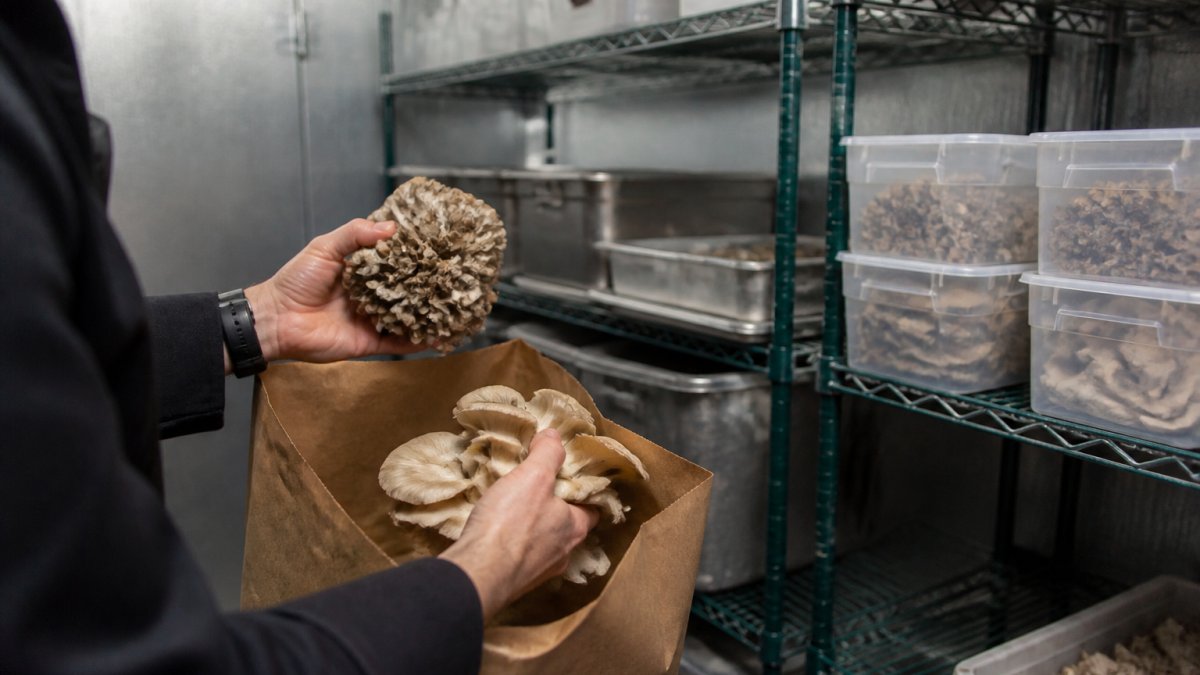
Fresh mushrooms store best in a paper bag in the refrigerator, where airflow keeps them dry and firm for several days. Skip plastic wrap, which traps moisture and speeds spoilage.
Evaluating Freshness on Delivery
Inspect every delivery before it goes into the cooler. A few checks catch most problems early:
- Smell: fresh mushrooms smell earthy and clean. A sour, fishy, or ammonia-like odor means they are past their prime.
- Texture: caps should be firm and dry, not slimy or tacky. Soft spots and dark, translucent patches are signs of breakdown.
- Color: look for even color for the variety. Oyster mushrooms should be bright, not yellowing; shiitake caps should be dry, not wet.
Reject or flag anything that fails these checks before it enters your rotation. It is easier to resolve with a supplier on delivery day than after the product has been in your cooler for three days.
Variety-by-Variety Storage and Shelf Life
Not all mushrooms store the same way. Delicate varieties bruise and break down faster; firm varieties hold longer. Use this as a working guide and adjust to what you see in your own cooler:
| Variety | Storage Notes | Typical Shelf Life |
|---|---|---|
| Oyster | Most delicate; keep in a single layer or loose paper bag, away from heavy items | 4-6 days |
| Lion's mane | Keep dry and breathable; bruises easily | 5-7 days |
| Maitake | Store in clusters; tear only at service | 5-7 days |
| Matsutake | Wrap loosely; aroma fades with time | 3-5 days |
| Lobster | Keep dry; color dulls as it ages | 3-4 days |
| Shiitake | Firm and forgiving; paper bag or breathable container | 7-10 days |
| King trumpet | Firmest; holds well in breathable containers | 7-10 days |
| Chestnut | Firm; store like shiitake | 5-7 days |
A Service-Week Storage Routine
Here's a storage routine that survives a full service week:
- Keep mushrooms in paper bags or breathable containers, never sealed plastic.
- Store them dry; wash only right before cooking.
- Label by delivery date and rotate oldest first.
Reducing Waste and Extending Yield
Waste is a cost problem as much as a quality problem. A few habits help:
- Order delicate varieties close to service. Oysters and lion's mane have the shortest windows; order smaller, more frequent deliveries rather than one large drop.
- Use trim intentionally. Stems and trim from shiitake and king trumpet can go into stocks, duxelles, or staff meal.
- Blanch and freeze surplus. If a wild window closes with product left, blanch and freeze for soups or braises.
Building a Seasonal Menu with Mushroom Direct
Building a seasonal menu starts with knowing what peaks when and having a supplier who can deliver it fresh. Mushroom Direct grows gourmet mushrooms at our Queens urban farm and delivers them to kitchens across New York.
Our fresh gourmet medley box rotates through lion's mane, maitake, king oyster, chestnut, and oyster mushrooms. For wild windows, our foraged matsutake and lobster mushrooms let you run limited features while the season holds.
Frequently Asked Questions
Which mushrooms are in season throughout the year?
Farmed varieties such as Oyster mushrooms, King Trumpet, Shiitake, and Chestnut are a practical base for a standing menu. Wild foraged picks are the opposite: Matsutake and Lobster Mushrooms appear only in short windows and cannot be scheduled. Build your standing menu on the farmed group and treat the wild ones as limited-time features.
What is the difference between wild and cultivated mushrooms?
Cultivated mushrooms are grown on a controlled substrate, which makes size, texture, and supply predictable from week to week. Wild mushrooms are foraged and vary by weather, region, and harvest date, so flavor can be more intense but volume is never guaranteed. For chefs, the practical split is menu reliability versus menu excitement: keep cultivated varieties as your base and slot wild foraged ones in as specials.
How should chefs store fresh mushrooms?
Keep fresh mushrooms cold, dry, and breathing. Store them in paper bags or breathable containers in the refrigerator rather than sealed plastic, which traps moisture and speeds softening. Do not wash them until service; brush or wipe instead. King Trumpet holds 7 to 10 days stored this way, while softer oyster varieties are best used within a few days of delivery. Label by harvest date so first-in-first-out is obvious.
Which seasonal mushroom varieties work best in soups and sauces?
Dried wild Morel and dried Chanterelle are built for this. Soak them in warm water, then strain the soaking liquid and use it as a stock base for soups, sauces, gravies, and risottos. The dried mushrooms themselves rehydrate into a concentrated, earthy flavor, and they can be ground into a powder to season savory dishes. Fresh Shiitake, available year-round, adds deep umami to broths and noodle dishes.
How can chefs choose mushrooms for a seasonal menu?
Start with what your supplier can actually deliver that week, then build the dish around texture and flavor rather than the other way around. Firm varieties like King Trumpet and Maitake hold up to roasting and grilling; delicate oyster mushrooms suit quick sautés and pasta. Order a rotating medley box to test unfamiliar varieties before committing them to a full menu change.
The challenge is real: wild windows close fast, and a menu built on a single supplier can leave you short mid-week. Mushroom Direct solves that with peak-freshness harvests, hard-to-find specialty varieties, and next-day delivery on featured boxes. Order today and cook with it tomorrow. Get started with Mushroom Direct and build a menu that changes with the season.
