

7 Steps to the Best Way to Grill Oyster Mushrooms
Last Updated: November 10, 2026
Quick Summary
The best way to grill oyster mushrooms is over medium heat, roughly 375°F to 400°F, with the lid closed for most of the cook. Oil the grates, place clusters cap-side down, and cook 3 to 4 minutes per side for thin clusters and 4 to 5 minutes per side for thicker ones.
- Brush off dirt with a damp paper towel and never soak oyster mushrooms, since wet caps steam instead of sear.
- Toss clusters in an oil-forward marinade and let them sit only 10 to 15 minutes before grilling.
- Preheat the grill 10 to 15 minutes with the lid down so the grate doesn't tear the caps.
- Thread clusters onto skewers with caps overlapping slightly to stop them falling through the grates.
- Grilled mushrooms keep about three days in a sealed container and reheat best in a hot skillet.
Table of Contents
- What You'll Need Before You Grill Oyster Mushrooms
- Step 1: Choose and Prepare Your Mushroom Clusters
- Step 2: Build a Grilled Oyster Mushrooms Marinade
- Step 3: The Best Way to Grill Oyster Mushrooms on a Gas Grill
- Step 4: Grill Oyster Mushroom Skewers and Slices Without Sticking
- Step 5: Grilled King Oyster Mushrooms as Steaks and Planks
- Timing Chart, Doneness Cues, and Troubleshooting
- Order Fresh Oyster Mushrooms for Your Next Grill Night
- Frequently Asked Questions
What You'll Need Before You Grill Oyster Mushrooms
The best way to grill oyster mushrooms starts with the right setup, not the right recipe. Oyster mushrooms are delicate, thin-capped fungi that turn soggy or scorch fast, so a little prep work before they hit the grates makes the difference between a rubbery pile and a crisp, smoky side dish.
Here's what to gather:
- Fresh oyster mushroom clusters, roughly 1 pound for four people
- Olive oil or another high-heat oil
- Kosher salt and freshly cracked black pepper
- Wooden or metal skewers, soaked if wooden
- A grill basket or a sheet of aluminum foil
At Mushroom Direct, we grow oyster mushrooms in small batches on our Queens farm. Freshness matters here more than with most vegetables: older mushrooms hold more water and collapse on the grates.
USDA guidance on selecting and storing fresh mushrooms
Step 1: Choose and Prepare Your Mushroom Clusters
Start by picking clusters with firm, dry caps and clean, white gills. Skip any that feel slimy, smell sour, or show dark, wet spots. If you want a quick visual check, our guide on how to identify fresh oyster mushrooms walks through color, texture, gill condition, and smell.
To prepare:
- Brush off loose dirt with a damp paper towel. Do not soak them.
- Trim the tough base of the cluster where it connected to the substrate.
- Pull or cut the cluster into smaller pieces, keeping caps attached to short stems.
Trimming Stems and Separating Clusters
Oyster stems are fibrous and chewy, so trim them to about half an inch below each cap. Tear large clusters into pieces roughly the size of your palm. Smaller pieces fall through the grates; bigger ones cook unevenly, with burnt edges and a raw center.
If you want to try a few varieties side by side, the oyster mushroom variety mix includes rotating Grey, Blue, White, and Mediterranean types in one box. Or start simple with a pack of fresh white oyster mushrooms, which have the most delicate flavor of the bunch.


Watch out: rinsing clusters under running water is the most common prep mistake. Oyster caps act like sponges, and wet mushrooms steam instead of sear.
Step 2: Build a Grilled Oyster Mushrooms Marinade
A good grilled oyster mushrooms marinade does two jobs: it adds flavor and it keeps the thin caps from sticking and burning. Keep it simple and oil-forward.
Whisk together:
- 3 tablespoons olive oil
- 1 tablespoon soy sauce or tamari for gluten-free
- 1 tablespoon lemon juice or rice vinegar
- 1 minced garlic clove
- 1/2 teaspoon kosher salt
For a teriyaki glaze, swap the lemon for a teaspoon of honey and a splash more soy.
Toss the clusters gently and let them sit for 10 to 15 minutes. Any longer and the acid starts breaking down the caps.
Oil, Salt, and Pepper: The Base That Prevents Burning
Oil is the barrier between the mushroom and the hot grate. Use enough to coat every surface, but not so much that it drips and flares. Salt draws out moisture, so add it just before grilling rather than an hour ahead. Pepper goes on last, since it burns faster than the mushrooms do.
Step 3: The Best Way to Grill Oyster Mushrooms on a Gas Grill
The best way to grill oyster mushrooms on a gas grill is over medium heat, roughly 375°F to 400°F, with the lid closed for most of the cook. High heat chars the thin caps before the inside firms up, and low heat lets them steam in their own moisture until they turn rubbery.
Here's the sequence:
- Preheat the grill for 10 to 15 minutes with the lid down. A cold grate grabs the caps and tears them.
- Scrub the grates clean and oil them with a folded paper towel held in tongs. Oil the grate, not just the mushrooms.
- Place clusters cap-side down first, then turn once. Resist the urge to poke at them.
- Close the lid and cook 3 to 4 minutes per side for thin clusters, 4 to 5 minutes per side for thicker ones.
- Move glazed pieces to the cool side for the last two minutes so the sugar doesn't scorch.
Direct vs Indirect Heat and When to Use Each
Direct heat gives you browning and smoky char, and it suits small clusters and slices. Indirect heat, with the burners on one side off and the mushrooms on the cool side, suits larger clusters and king oyster planks that need to cook through without scorching.
The rule we use: thin pieces over direct heat, thick pieces over indirect heat, and anything glazed with sugar moved to the cool side for the final minutes.
Adapting the Method to Charcoal, Indoor Grills, and Grill Baskets
A charcoal grill works the same way, with coals banked to one side and a hot side and cool side to work between. That same balance of hot and cool zones helps over an open fire, where AdjustaGrill can make heat easier to manage as you cook.
An indoor grill pan or cast-iron skillet works for apartment cooks and rainy nights.
A grill basket is the best tool for loose slices and small pieces that would otherwise fall through the grates.
Watch out: on any grill, crowding the grate is the fastest way to soggy mushrooms. Leave space between pieces so the moisture can escape as steam instead of pooling.
Step 4: Grill Oyster Mushroom Skewers and Slices Without Sticking
Grilled oyster mushroom skewers solve the two biggest problems: pieces falling through the grates and uneven cooking. Thread clusters onto skewers so the caps overlap slightly, which keeps them moist and stops them spinning when you turn the skewer.
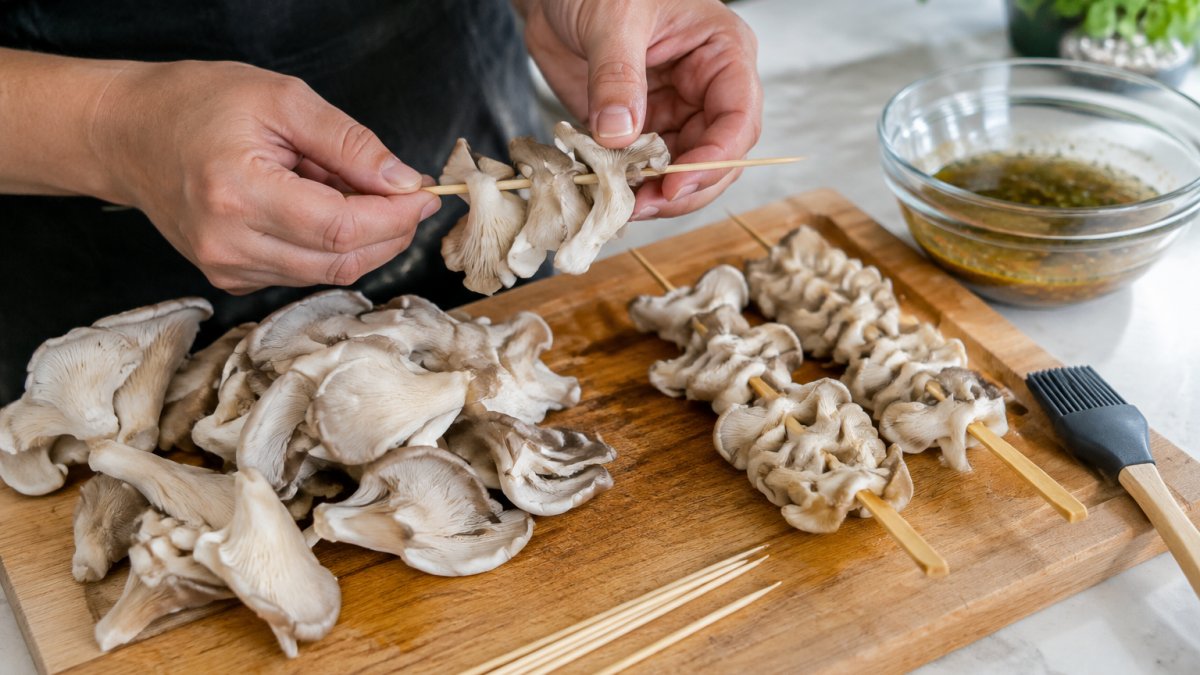
For loose slices and smaller pieces, use a grill basket or a foil packet with a few holes poked in the top. Both keep the mushroom slices together and let smoke in.
Three habits prevent sticking:
- Oil the grates, not just the mushrooms
- Turn with tongs, not a fork, so you don't pierce the caps
- Wait for a clean release before flipping; if it sticks, it isn't ready
Expect slices to shrink and reduce in size by about a third as they lose water. That's normal.
Step 5: Grilled King Oyster Mushrooms as Steaks and Planks
Grilled king oyster mushrooms are the steak of the mushroom world. Their thick, meaty stems hold up to high heat and slice into rounds or long planks that brown like a scallop.
To make them:
- Trim the caps off and slice each stem lengthwise into 1/2-inch planks.
- Score the flat side in a crosshatch pattern, about 1/4 inch deep.
- Brush both sides with oil and season with salt.
- Grill over medium heat, 4 to 5 minutes per side, until deeply browned.
Score marks let the marinade soak in and stop the planks from curling. For the firmest texture, order king oyster fresh mushrooms or fresh king trumpet mushrooms, both grown for that dense, meaty bite.

Timing Chart, Doneness Cues, and Troubleshooting
Timing depends on variety, thickness, and heat, so use this chart as a starting point and your eyes as the final judge.
| Mushroom Type | Heat | Time per Side | Doneness Cue |
|---|---|---|---|
| White or grey oyster clusters | Medium direct | 3-4 min | Edges lightly browned, caps tender |
| Blue oyster clusters | Medium direct | 4-5 min | Firm bite, deep golden edges |
| Oyster slices in a basket | Medium direct | 2-3 min | Reduced in size, dry surface |
| Oyster skewers | Medium direct | 3-4 min | Juicy inside, charred at the edges |
| King oyster planks | Medium, then indirect | 4-5 min | Deep brown crust, chewy center |
Time per Side
How to Tell They're Done Without a Timer
Grilled oyster mushrooms are done when the caps are tender, lightly browned at the edges, and reduced in size, with no raw white center when you peek at a thick piece.
For king oyster planks, press the center with a finger. A finished plank gives slightly and springs back, while an undercooked one feels rigid and slick. The crosshatch score marks should be browned and the edges crisp.
Troubleshooting Common Grilling Problems
- Sticking to the grate: The grate wasn't oiled, or you flipped too early. Oil the grate with a folded paper towel held in tongs, and wait for a clean release before turning. If a piece sticks, give it another 30 seconds; it will release on its own.
- Falling through the grates: Small pieces and separated caps slip between bars. Use a grill basket, a foil packet, or skewers threaded so the caps overlap slightly.
- Burning before tender: Heat is too high or the piece is too thin. Move it to the cool side, close the lid, and let it finish over indirect heat.
- Drying out and turning leathery: Too little oil or too long on the grill. Brush with oil before cooking and pull pieces as soon as the edges brown.
- Soggy or steaming: The mushrooms were wet going on, or the grate was crowded. Pat them dry, oil them, and leave space between pieces.
One more safety note: handle raw mushrooms and cooked food with separate utensils, and refrigerate leftovers within two hours, per FDA food safety guidance. Grilled mushrooms keep about three days in a sealed container and reheat best in a hot skillet, not the microwave.
Order Fresh Oyster Mushrooms for Your Next Grill Night
The best grilled mushrooms start with mushrooms that were fresh when they hit your kitchen. Ours are harvested in small batches on our Queens farm, grown on organic agricultural by-products, and delivered fast enough that the clusters still smell like the farm, not the cooler.
Great grilling comes down to fresh mushrooms, a simple oil-based marinade, and the right heat.
Frequently Asked Questions
How long should oyster mushrooms cook on the grill?
Thin clusters and separated caps need about 3 to 4 minutes per side over medium heat, roughly 8 minutes total. Whole clusters take 10 to 12 minutes, turned once or twice. King oyster planks need 5 to 6 minutes per side because of their density. Treat these as starting points and pull the mushrooms when the edges are lightly browned and the caps have reduced in size, since grate temperature and cluster thickness vary.
Can you grill oyster mushrooms directly on the grates?
Yes, but only larger clusters or thick king oyster planks. Small caps and loose slices fall through the grates, so use a grill basket, aluminum foil, or skewers for those. For direct grilling, clean and oil the grates, keep the mushrooms moving with tongs, and use medium heat rather than high. If you grill oyster mushrooms on a gas grill, the controlled burners make it easier to hold a steady medium heat on one side.
Should you marinate oyster mushrooms before grilling?
A short marinade helps, but keep it brief. Oyster mushrooms are thin and absorb liquid fast, so 15 to 30 minutes in a grilled oyster mushrooms marinade of oil, salt, pepper, and an acid is enough. Longer soaks make them soggy and prone to steaming instead of browning. Pat off excess marinade before they hit the grates so the oil does not flare up, and brush on any sticky glaze during the last minute of cooking.
How do you keep grilled oyster mushrooms from drying out?
Coat them fully in oil before grilling and cook over medium heat, not high. High heat drives out moisture before the outside browns. Keep clusters intact rather than separating every cap, and avoid pressing them with a spatula. If they start to look shriveled, move them to the cool side of the grill, cover, and finish with indirect heat. A light brush of oil or glaze right after they come off the grates also restores shine and moisture.
