

How to Identify Fresh Oyster Mushrooms
Last Updated: October 26, 2026
Quick Summary
To identify fresh oyster mushrooms, look for a firm cap that springs back when pressed gently, tightly packed cream to pale yellow gills, uniform color without dark spots or browning, and a mild earthy smell with no sour or ammonia-like odor. The mushroom should feel slightly moist but never slimy, with a thin delicate cap margin that is not papery or shriveled.
- Fresh oyster mushrooms feel firm and spring back when pressed, with dense slightly moist flesh that resists indentation.
- Gills should be tightly packed, cream to pale yellow, attached to the stem without gaps, and never brown, dark grey, or slimy.
- Color should be uniform across the cap; white oysters cream to ivory, grey oysters silvery-grey, blue oysters blue-grey without browning or fading.
- A fresh oyster smells earthy and mild with a faint piney or woody note; sour, ammonia-like, rotten, or musty smells indicate spoilage.
- Peak quality lasts 5 to 7 days refrigerated in a breathable paper bag at 35-40°F, but wild oysters typically last only 3 to 4 days.
Table of Contents
- Understanding Oyster Mushroom Freshness vs. Species Identification
- How to Identify Fresh Oyster Mushrooms by Appearance
- Checking Smell and Other Sensory Indicators
- How to Tell if Oyster Mushrooms Are Bad
- How to Store Fresh Oyster Mushrooms
- How Long Do Oyster Mushrooms Last in the Fridge
- Freshness Differences Between Cultivated and Wild Oyster Mushrooms
- Getting Peak-Fresh Oyster Mushrooms for Your Kitchen
- Frequently Asked Questions
Understanding Oyster Mushroom Freshness vs. Species Identification
Identifying an oyster mushroom as a species and judging whether it's fresh are two different skills. A perfect specimen can be three days old and declining; a clearly identifiable oyster can be past its prime. Learning to identify fresh oyster mushrooms means knowing what to look for right before you cook.
At Mushroom Direct, we harvest in small batches and deliver within hours. Whether you shop at a farmers market, order online, or pick from your own supply, the same visual and sensory checks apply.
Species identification focuses on cap shape, gill structure, and growing patterns; freshness assessment focuses on texture, firmness, color vibrancy, and smell. A fresh oyster mushroom should feel firm, slightly moist but never slimy, with no dark spots and nothing beyond a mild, earthy scent.
How to Identify Fresh Oyster Mushrooms by Appearance
Fresh oyster mushrooms show specific visual markers. The most reliable sign is structure: the cap should feel springy when pressed gently, and the gills should be tightly packed and clearly visible, not collapsed or darkened.
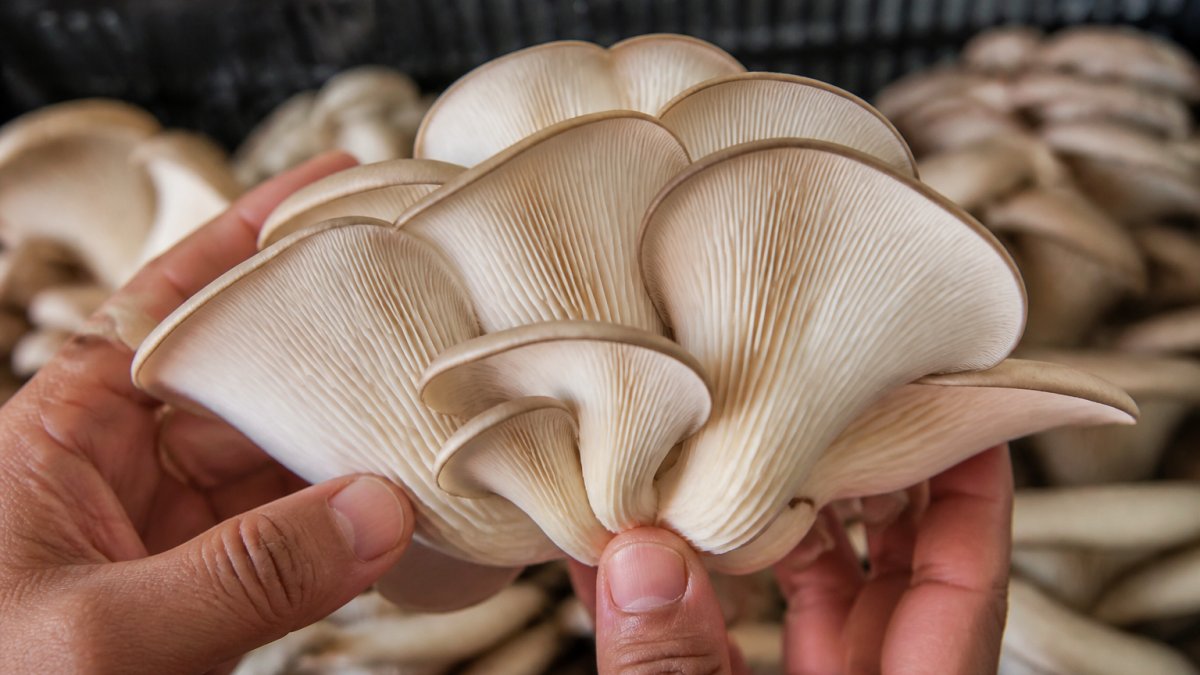
Color matters, but each variety has its own natural range. White oysters should be cream to ivory, grey oysters silvery-grey without dark patches, and blue oysters distinctly blue-grey without browning at the edges. The key is uniform color across the cap, not blotchy or discolored.
Color and Cap Shape
A fresh cap has a fan or oyster-shell shape with edges that curl slightly inward or stay flat. The margin should be thin and delicate, not thickened or rolled under. A papery, shriveled, or severely curled-down margin means significant moisture loss and past-peak mushrooms.
Color should be consistent from center to edge; fading, browning, or yellowing at the margins signals aging.
The cap surface itself should look slightly moist but not wet or sticky. A light sheen is normal. Sticky or slimy surfaces indicate bacterial growth and spoilage.
Texture and Firmness
Press gently with your thumb: a fresh oyster resists and springs back, with dense, slightly moist flesh. An indent that doesn't recover means deterioration.
The cap surface should feel smooth or slightly velvety, never rough, cracked, or papery. The gills underneath should feel slightly damp, not wet or slimy.
Older mushrooms lose water content, becoming lighter than their size suggests and feeling hollow or papery. A fresh oyster feels substantial in your hand.
Gill Attachment and Appearance
Flip the mushroom over. Gills should be tightly packed from stem to cap edge and cream to pale yellow, depending on variety, not brown, dark grey, or black unless that's natural for your variety.
Gills should attach to the stem (or run down it slightly) without gaps. Pulling away means drying out; slimy, discolored, or matted gills indicate decay.
Fresh gills feel delicate but intact; aged ones feel papery or crumble easily.
Checking Smell and Other Sensory Indicators
Smell is an underrated freshness check. A fresh oyster should smell earthy and mild, with a faint piney or woody note depending on variety, and nothing unpleasant.
A sour, ammonia-like, rotten, musty, or moldy smell means spoilage, discard immediately. Trust your nose: if something smells off, it is off.
Blue and grey varieties may carry a subtle resin-like note, which is normal and a sign of freshness. The smell should be pleasant, never sharp or offensive.
How to Tell if Oyster Mushrooms Are Bad
Spoilage is progressive, not instant. Decline typically unfolds in this order: moisture loss, texture breakdown, microbial growth, then odor.
Stage 2, Texture breakdown (use immediately or discard). The cap no longer springs back, gills mat together, and the surface feels tacky.
Stage 3, Microbial growth (discard). Visible slime, black or green spots, fuzzy mold, or dark brown to black gills indicate colonization.
A quick discard rule. Discard if any one is true: visible slime, visible mold, dark gills with soft texture, a strong unpleasant odor, or a package left sealed and wet. When in doubt, throw it out, a discarded pint costs far less than foodborne illness.
Cross-contamination. If one mushroom is spoiled, don't assume the rest are fine. Spoilage spreads through shared moisture and contact.
Fresh White Oyster Mushrooms →
Spoilage progresses through four distinct stages, each with visible and sensory signs.
| Stage | Signs | Action |
|---|---|---|
| Stage 1: Moisture loss | Papery cap margin, dry brittle gills, light weight | Use soon, still safe |
| Stage 2: Texture breakdown | Cap doesn't spring back, matted gills, tacky surface | Use immediately or discard |
| Stage 3: Microbial growth | Visible slime, black or green spots, fuzzy mold | Discard entire container |
| Stage 4: Odor | Sour, ammonia-like, fishy, or rotten smell | Discard immediately |
How to Store Fresh Oyster Mushrooms
Refrigerate oyster mushrooms as soon as you bring them home, in a paper bag or breathable container, never sealed plastic. They need air circulation, and plastic traps moisture and accelerates decay.
Place the bag in the vegetable drawer at 35-40°F, away from ethylene-producing fruits like apples and bananas, which speed ripening and decay.
Do not wash oyster mushrooms before storage. Excess moisture promotes mold growth. Wipe them gently with a dry cloth if needed just before cooking.
How Long Do Oyster Mushrooms Last in the Fridge
Oyster mushrooms hold peak quality for about 5 to 7 days refrigerated, but that's a ceiling, not a guarantee. What matters is how much of that window was used up before the mushrooms reached your kitchen, a batch harvested yesterday and one that spent three days in a distribution cooler look similar but have very different remaining life.
What drives shelf life. Four factors dominate:
- Temperature. Oyster mushrooms decline fastest above 40°F. The sweet spot is 35-38°F, which is colder than most refrigerator doors and closer to the back of the main compartment. A fridge set to 40°F will shorten the window by roughly a day or two compared with one held near 36°F.
- Moisture balance. Too much surface water accelerates bacterial growth; too little causes the papery, brittle decline described above. The goal is high humidity without standing water, which is why breathable packaging outperforms sealed plastic.
- Airflow. Oyster mushrooms are living tissue and continue to respire after harvest. Sealed containers trap carbon dioxide and moisture, which speeds softening and sliminess. A paper bag or a container with vents lets gas exchange continue.
- Handling. Every bruise is a entry point for spoilage organisms. Mushrooms that were compressed in a crowded bin or dropped during transport decline faster than gently handled ones, even at the same temperature.
Packaging trade-offs. A paper bag is the default because it breathes and absorbs surface moisture; cotton or mesh works similarly.
How to tell where a batch sits on the timeline. Use the mushroom's signals, not the calendar. Day 1-2: firm caps, tight gills, even color. Day 4-5: slight margin thinning and color fade, still good, but plan to cook.
Freezing as a stopgap. If you cannot use mushrooms within the window, freezing extends storage to several months, but the texture changes: thawed oyster mushrooms are soft and best suited to cooked dishes such as soups, stews, and sautés rather than raw or crisp applications.
Wild versus cultivated timelines. Wild-foraged oysters generally have a shorter refrigerator life, often 3 to 4 days, because they arrive with more handling stress, variable moisture, and possible insect activity. Inspect wild specimens more carefully and use them sooner. Cultivated mushrooms from a controlled environment start cleaner and more uniform, which is why they reliably hit the 5-7 day range when stored well. Regardless of their origin, these fungi offer distinct textures that change significantly during high-heat cooking, a nuance explored when comparing oyster versus shiitake mushrooms.
Freshness Differences Between Cultivated and Wild Oyster Mushrooms
Cultivated oyster mushrooms, the kind grown on substrate in controlled environments, are what most home cooks encounter. They're reliable, consistent, and available year-round.
Wild oyster mushrooms, found on hardwood trees in forests, have more variation in appearance.
The freshness assessment remains the same for both: firmness, color saturation, tight gills, and pleasant smell. The difference is in what "normal" looks like for each type.
Wild oysters typically have a shorter shelf life because they're exposed to more environmental stress during foraging and transport. Use wild oysters within 3-4 days of purchase.
Getting Peak-Fresh Oyster Mushrooms for Your Kitchen
The simplest way to ensure you're working with truly fresh oyster mushrooms is to source them from growers who prioritize speed from harvest to your hands.
We offer Fresh White Oyster Mushrooms, Fresh Grey Oyster Mushrooms, and Fresh Blue Oyster Mushrooms harvested fresh and delivered with next-day free shipping on featured boxes.


After you've selected fresh oyster mushrooms, learn how to use them. Check out our Best Oyster Mushroom Recipes 2026 for techniques that highlight their texture and flavor. And if you want a broader understanding of mushroom freshness beyond oyster varieties, our guide on How To Tell If Mushrooms Are Fresh covers the universal signs that apply across all mushroom types.
Store them properly in a paper bag in your refrigerator, use them within 5-7 days, and you'll have mushrooms that cook beautifully and taste like they were picked hours before your meal. That's what peak freshness means.
Frequently Asked Questions
How can you tell if oyster mushrooms are fresh?
Fresh oyster mushrooms have firm, springy caps with no soft spots or sliminess. Check for uniform color without dark bruises, tight gills that are firmly attached to the stem, and a pleasant earthy or slightly piney smell. Avoid mushrooms with a sour or ammonia-like odor, which signals spoilage. Freshly harvested oyster mushrooms feel substantial when held and show no liquid weeping from the gills.
What should fresh oyster mushrooms smell like?
Fresh oyster mushrooms have a mild, earthy aroma, sometimes with subtle piney or woody notes depending on the variety. White and grey oyster mushrooms typically smell faintly earthy, while blue oysters may have a slightly more pronounced woodsy scent. Any sour, bitter, or ammonia-like smell indicates bacterial growth or advanced spoilage. If the smell is unpleasant or chemically off, discard the mushrooms.
How to tell if oyster mushrooms are bad: what are the main spoilage signs?
Spoiled oyster mushrooms show sliminess, dark brown or black spots, a sour or ammonia odor, and soft, mushy texture. Liquid may pool on the cap or drip from the gills. The edges may appear waterlogged or translucent. If gills look darkened or slimy, the mushrooms are no longer safe to eat. Discard any mushrooms showing these signs; spoilage can harbor harmful bacteria.
How long do oyster mushrooms last in the fridge after purchase?
Properly stored oyster mushrooms last 5-7 days in the refrigerator when kept in a paper bag or breathable container in the crisper drawer. Avoid plastic bags, which trap moisture and accelerate spoilage. Check them every 2-3 days for firmness and smell. Mushrooms harvested and delivered fresh (within hours of picking) will stay fresh longer than those that have already sat in transit or storage elsewhere.
The difference between a mediocre mushroom dish and an exceptional one often comes down to starting with genuinely fresh ingredients. Learning to identify fresh oyster mushrooms puts that control in your hands. You'll know exactly what you're working with, and you'll cook with confidence knowing your mushrooms are at their best.
