

Farm to Table Mushrooms: 7 Benefits for Home Cooks
Last Updated: October 23, 2026
Quick Summary
Farm to table mushrooms are harvested locally and reach your kitchen within hours or days, skipping the long warehouse chain. That short trip delivers firmer texture, deeper umami, better nutrition, less packaging waste, and support for local growers and jobs.
- A locally grown mushroom is often cooked within 24 hours of harvest.
- Mushrooms are grown on agricultural by-products like legume hulls and brewers' spent grain.
- Store fresh mushrooms in a paper bag in the fridge for 5-7 days.
- Do not wash mushrooms until you cook them, since moisture speeds spoilage.
- Cook mushrooms thoroughly before eating and discard anything slimy or sour-smelling.
Table of Contents
- What Farm to Table Mushrooms Actually Mean for Your Kitchen
- Peak Freshness and Flavor You Can Taste
- Mushroom Nutrition Benefits That Survive the Short Trip
- How Sustainable Mushroom Farming Closes the Loop
- The Benefits of Locally Grown Mushrooms for Growers and Communities
- How to Store Fresh Mushrooms So Nothing Goes to Waste
- Food Safety, Handling, and Traceability in Local Mushroom Supply
- Conclusion
- Frequently Asked Questions
What Farm to Table Mushrooms Actually Mean for Your Kitchen
Farm to table mushrooms are gourmet and specialty mushrooms harvested on a local farm and delivered to kitchens within hours or days, skipping the long warehouse and distribution chain that standard supermarket mushrooms travel through. At Mushroom Direct, we grow in small batches at our Queens urban farm and get fresh mushrooms from our racks to your door in a matter of hours. That short trip is the whole point. The benefits of farm to table mushrooms start with flavor you can actually taste, then extend to nutrition, sustainability, and the local economy.
Below, we break down seven benefits, plus the storage and food-safety know-how that makes local sourcing pay off. Most guides stop at "buy local, it's nice." That misses the real mechanics: why freshness changes texture, how substrate choices affect waste, and what to check before you buy. Understanding these nuances reveals how local ingredient sourcing transforms the culinary potential of every mushroom variety you bring into your kitchen.
Peak Freshness and Flavor You Can Taste
Freshness is the benefit you notice first. A mushroom is mostly water, and the moment it's picked, it starts losing moisture and aroma. A supermarket mushroom may sit in a distribution warehouse for days before it reaches the shelf. A locally grown mushroom is often cooked within 24 hours of harvest.
That gap shows up on the plate:
- Firmer texture that sears instead of steaming
- Deeper umami in Lion's Mane and Shiitake
- Cleaner, nuttier notes in Chestnut and King Trumpet
- Better browning because less surface moisture means a real crust
What most guides miss is that flavor loss is not gradual and invisible. It is fast. Oyster mushrooms in particular thin out and turn papery within days. When you buy from a local grower, you are buying time back.

Mushroom Nutrition Benefits That Survive the Short Trip
Mushroom nutrition benefits hold up best when the mushroom is fresh. Gourmet varieties bring protein, dietary fiber, B vitamins, potassium, and minerals to the plate, and they do it with very few calories. Oyster and King Trumpet mushrooms are naturally rich in protein and fiber. Shiitake adds vitamin D and antioxidants.
The catch is time. Nutrients and texture degrade as mushrooms age, and water loss concentrates nothing good. A short supply chain protects both. Local mushrooms reach your kitchen closer to their harvest peak, so the nutrition you read about is closer to the nutrition you eat.
For anyone building plant-based meals, this matters. Mushrooms deliver savory depth and a meaty bite that vegetables alone struggle to match. A fresh King Trumpet seared in rounds gives you that scallop-like crust. A tired one just releases water.
How Sustainable Mushroom Farming Closes the Loop
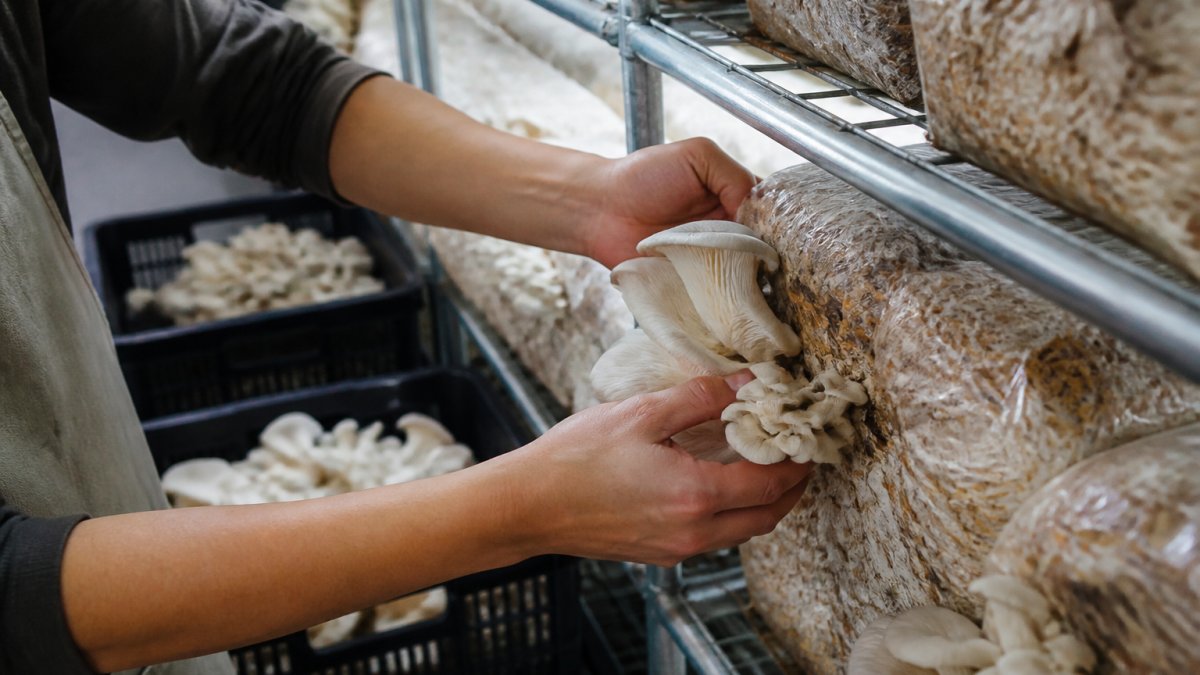
Most sustainability claims about local food stop at food miles. Mushrooms are a case where that shortcut is misleading. A mushroom's footprint is dominated by what it grows on, how its room is heated and cooled, and how it is packaged and delivered, not just how far it travels.
Substrate: the biggest lever. Mushrooms are not grown in soil. They are grown on agricultural and forestry by-products, legume hulls, brewers' spent grain, straw, hardwood sawdust, cocoa shells, coffee chaff. At our farm we cultivate on organic material like legume hulls and brewers' spent grain that would otherwise be waste.
Energy for climate control. Indoor mushroom rooms need steady temperature and humidity, and that means electricity and often heating or cooling. Vertical indoor growing saves land, but it does not save energy.
Land and water. Mushrooms are efficient on both. They grow vertically indoors rather than on cleared acreage, and controlled indoor growing uses water efficiently compared with field crops. That is a genuine advantage, but it is an advantage over field agriculture, not a free pass on the rest of the chain.
Packaging and delivery. Imported mushrooms arrive by truck or air freight, cooled the whole way and wrapped in plastic. A local grower replaces that with a short drive, but the last mile still matters.
The waste loop. When the harvest is done, spent substrate goes to feed worms and becomes natural fertilizer, closing the loop back to soil. That step is what makes the system circular rather than merely low-impact.
The environmental impact comparison is not close on transport, but it is closer than most guides admit on energy and packaging.
The Benefits of Locally Grown Mushrooms for Growers and Communities
The benefits of locally grown mushrooms reach past your dinner plate. Direct purchasing changes who captures the margin and how much of each dollar stays in the regional food economy.
Where the money goes. In a conventional chain, a mushroom passes through a distributor and a retailer before it reaches a chef or home cook, and each link takes a cut. A direct farm-to-table sale collapses those links. For a small grower, that margin is the difference between competing on volume against large wholesale operations and competing on quality, variety, and freshness.
Fresh Gourmet Medley Box | Free Next Day Delivery →

Jobs and the local business cluster. Small mushroom farms create skilled jobs, harvesters, packers, delivery drivers, sales staff, that cannot be offshored. They also anchor a cluster of nearby food businesses: restaurants that build menus around a reliable local supply, farmers markets, specialty grocers, and composters who take spent substrate. That cluster is the resilience argument in concrete form. When a distant truck is delayed, a supermarket runs out; a local farm can harvest and deliver the same day.
Resilience and risk. A short supply chain has fewer links to break. Direct relationships also give growers faster feedback, a chef who wants a specific variety or size can ask for it, and a grower can adjust the next flush.
Access and variety for cooks. Local growers tend to carry varieties the supermarket never stocks: Maitake, Blue Oyster, Lion's Mane, and seasonal foraged Chanterelle and Lobster mushrooms. That variety is not a luxury. It is the difference between a routine sauté and a dish worth repeating.
Seasonality and local availability. Farm-to-table mushrooms are not all available year-round, and pretending otherwise sets cooks up for disappointment. A practical guide:
| Variety | Typical local availability | Notes |
|---|---|---|
| Oyster (Blue, Pearl) | Year-round indoors | Fastest to lose quality; buy close to harvest |
| Lion's Mane | Year-round indoors | Best texture within days of harvest |
| King Trumpet | Year-round indoors | Holds longest of the cultivated varieties |
| Chestnut | Cooler months | Nutty flavor peaks in cool weather |
| Shiitake | Year-round indoors; outdoor logs in mild seasons | Log-grown has deeper flavor but tighter supply |
| Maitake | Late summer through fall | Highly seasonal; ask your grower |
| Chanterelle, Lobster | Foraged, seasonal | Supply depends on weather; confirm before planning a menu |
Indoor cultivated varieties are the reliable backbone of a local supply; foraged and log-grown varieties are the seasonal treats. A grower who tells you what is peaking this week is giving you a better menu.
How to Store Fresh Mushrooms So Nothing Goes to Waste
Knowing how to store fresh mushrooms is the difference between using the whole box and throwing half of it away. Mushrooms need airflow and hate trapped moisture. The fix is simple.
| Storage Method | Best For | Keeps For | Avoid |
|---|---|---|---|
| Paper bag in fridge | Most fresh varieties | 5-7 days | Sealed plastic |
| Damp cloth, open container | Oyster mushrooms | 3-5 days | Washing before storing |
| Dry paper towel + breathable bag | King Trumpet, Chestnut | 7-10 days | Stacking heavy |
| Cook first, then freeze | Surplus or bulk boxes | 2-3 months | Freezing raw and wet |
A few rules cover most of it:
- Do not wash until you cook. Moisture speeds spoilage.
- Keep them cold but not freezing. The main fridge compartment works.
- Separate varieties. Oysters release moisture faster than King Trumpet.
- Cook the delicate ones first. Oyster and foraged varieties go before firm ones.
If a box is bigger than you can use, sauté the surplus in butter or oil, cool it, and freeze. You get a ready-made base for pasta, risotto, or soup.
Food Safety, Handling, and Traceability in Local Mushroom Supply
Food safety in local mushroom supply comes down to three things: clean handling, clear cooking guidance, and a short, traceable chain. A local farm can usually tell you the harvest date, the variety, and the substrate. That traceability is hard to get from a packaged supermarket tray.
Handling rules for home cooks:
- Refrigerate promptly after delivery
- Cook mushrooms thoroughly before eating, as we recommend on every product page
- Discard anything slimy, sour-smelling, or darkened
- Keep raw mushrooms away from ready-to-eat foods on the counter
The FDA guidance on selecting and storing fresh produce is a useful reference for general handling. For mushrooms specifically, cooking is the key step. Raw mushrooms are not a salad ingredient, and thorough cooking is standard advice across the industry.
Traceability is where local wins outright. When you buy from a grower, you can ask questions and get answers. When something is off, you know who to call.
Conclusion
The challenge with farm to table mushrooms is not finding them. It is changing how you buy.
Mushroom Direct grows Lion's Mane, Blue Oyster, King Trumpet, Chestnut, Maitake, and seasonal foraged varieties at our Queens farm, with free next-day delivery on featured boxes and flexible sizes for home cooks and chefs. Our mushrooms are cultivated on organic agricultural by-products, and the spent substrate goes back into the soil cycle. Fresher than the supermarket, more flavorful than the wholesale truck, and grown close enough to taste the difference.

Add to cart and cook with them tomorrow.
Frequently Asked Questions
Are locally grown mushrooms fresher than store-bought mushrooms?
Usually yes. Supermarket mushrooms often travel through distribution warehouses and can sit for days before reaching the shelf. Local growers harvest in small batches and deliver within hours or a day, so the mushrooms arrive with tighter caps, drier surfaces, and better texture. Fresher farm to table mushrooms also hold up longer in your fridge because they start with less age on them.
How long do fresh mushrooms last after harvest?
Most fresh gourmet varieties keep 5 to 10 days in the refrigerator when stored properly. Firmer types like King Trumpet can last 7 to 10 days in a paper bag, while delicate oyster mushrooms are best used within 3 to 5 days. The clock starts at harvest, not at purchase, which is why locally grown mushrooms often outlast shipped ones by several days.
Can mushrooms be grown using agricultural byproducts?
Yes. Many sustainable mushroom farms grow on organic agricultural byproducts such as legume hulls and brewers' spent grain instead of virgin wood or peat. The mushrooms break down these materials and turn them into food, and the spent substrate can then be recycled as compost or worm feed. This circular approach reduces waste and keeps resources in the food system.
How do I store fresh mushrooms to keep them at their best?
Keep mushrooms in a paper bag in the main compartment of your fridge, not a sealed plastic container. Paper lets moisture escape while holding enough humidity to prevent drying. Avoid washing them until right before cooking; brush off debris with a damp cloth instead. Proper storage is one of the simplest ways to protect the mushroom nutrition benefits and texture you paid for.
