

How Do Restaurants Keep Mushroom Supply Chain Quality High?
Last Updated: November 5, 2026
Quick Summary
Restaurants keep mushroom supply chain quality high by protecting fresh mushrooms from harvest through delivery and storage, since every hour at room temperature shortens shelf life. Buyers enforce fast harvest-to-delivery times, real cold-chain control, written product specs, and a 10-minute receiving inspection that probes temperature first.
- A case left on a warm dock for two hours loses more quality than one that travels cold for two days.
- Ask suppliers how many hours pass between harvest and delivery and what temperature mushrooms are held at in transport.
- Probe a sample from the middle of the case before it goes anywhere, then smell, inspect, weigh, and log the results.
- Never wash mushrooms before storage, because water on the surface accelerates breakdown.
- Track spoilage by variety for a month to compare landed cost rather than sticker price.
Table of Contents
- Why Mushroom Supply Chain Quality Breaks Down Before Service
- What to Look For in Fresh Mushroom Suppliers for Restaurants
- The Restaurant Mushroom Supplier Checklist
- Receiving and Inspection: The 10-Minute Standard
- Fresh Mushroom Storage for Restaurants: Cold Chain and Inventory
- Mushroom Supply Chain Traceability and Food Safety Compliance
- Cost and Total Landed Cost for Restaurant Buyers
- Build Your Mushroom Order With Mushroom Direct
- Frequently Asked Questions
Why Mushroom Supply Chain Quality Breaks Down Before Service
Most mushroom supply chain quality problems start long before a pan hits the burner. Across New York kitchens, mushrooms often arrive looking fine, then collapse by Thursday service.
Mushroom supply chain quality is the practice of protecting fresh mushrooms from harvest through delivery and storage so they reach the plate with firm texture, clean aroma, and full flavor.
A mushroom keeps respiring after harvest, giving off heat and moisture and softening fast.
The Postharvest Clock: What Happens in the First 24 Hours
The first 24 hours after harvest decide most of what you taste. Mushrooms cooled quickly hold their structure; those left warm sweat, darken, and turn slippery.
Watch for these signs of decline:
- Caps that soften and curl at the edges
- Stems that feel hollow or spongy
- A sour or fishy smell from trapped moisture
If you want a practical way to judge what you are getting, this guide on how to tell if mushrooms are fresh covers the visual and touch cues buyers can check in seconds.
Where Quality Loss Actually Happens
Loss rarely happens in one dramatic moment. It adds up across the chain:
What to Look For in Fresh Mushroom Suppliers for Restaurants
The best fresh mushroom suppliers for restaurants share four traits: fast harvest-to-delivery times, real cold-chain control, honest communication about availability, and clear product specs. A cheap case that dies in two days is the most expensive purchase in your walk-in.
Ask every supplier these questions before you commit:
- How many hours pass between harvest and delivery?
- What temperature are mushrooms held at during transport?
- Can you hold consistent supply of Lion's Mane or Maitake year-round?
A supplier who cannot answer these plainly is a risk to your menu.
Farm Gate Versus Distribution Warehouse
Sourcing model changes everything about freshness. Farm gate means buying close to the grower, often with same-day or next-day harvest. Distribution warehouse means the product passes through one or more holding points before it reaches you.
Farm-gate buying usually wins on time and traceability: you know the grower, harvest window, and handling. Warehouse buying can win on volume and catalog breadth, but every holding point adds age.
For buyers weighing this trade-off, our guide on how to choose locally grown gourmet mushrooms breaks down what to ask and what to verify. If you are sourcing in the city, you can also review the wholesale mushroom program to see how a local farm structures ordering and delivery.
The Restaurant Mushroom Supplier Checklist
A restaurant mushroom supplier checklist turns a gut feeling into a repeatable decision. Use it before you sign, and again at every quarterly review.
- Harvest-to-delivery window stated in writing
- Cold chain maintained from farm to dock
- Written product specs by variety and grade
Run this list against any supplier, including us. A supplier that welcomes the questions is usually worth keeping.
Specifications and Service-Level Agreements
Put quality in writing. A spec sheet should list variety, grade, cap size range, stem condition, pack weight, and acceptable delivery temperature. A service-level agreement should state delivery windows, order cutoffs, substitution rules, and credits for rejected product.
Without specs, "fresh" is an opinion. With specs, it is a standard you can enforce at the door.
Supplier Scorecard: Measurable KPIs
Score every supplier monthly on a simple 1-5 scale. Track:
| KPI | What to Measure | Target |
|---|---|---|
| On-time delivery | Deliveries inside the agreed window | 95% or better |
| Spec compliance | Cases meeting grade and pack specs | 95% or better |
| Temperature at receipt | Product temp on arrival | Within your cold standard |
| Shelf life achieved | Usable days after delivery | Meets your menu cycle |
| Substitution rate | Orders changed without notice | Low and disclosed |
| Issue resolution | Time to fix a problem | Same business day |
Review scores quarterly. Suppliers that slip on two or more KPIs get a conversation, then a contingency plan.
Receiving and Inspection: The 10-Minute Standard
Receiving is where you win or lose the week. Set a 10-minute standard and hold every delivery to it.
- Check the temperature first. Probe a sample from the middle of the case before it goes anywhere.
- Smell the product. Fresh mushrooms smell clean and earthy. Sour or fishy means reject.
- Look at caps and stems. Firm caps, dry surfaces, intact stems.
- Check for moisture. Wet, slimy, or condensation-soaked product is a reject.
- Weigh and count. Confirm pack weights and variety counts against the invoice.
- Log the results. Date, supplier, variety, temperature, and pass or fail.
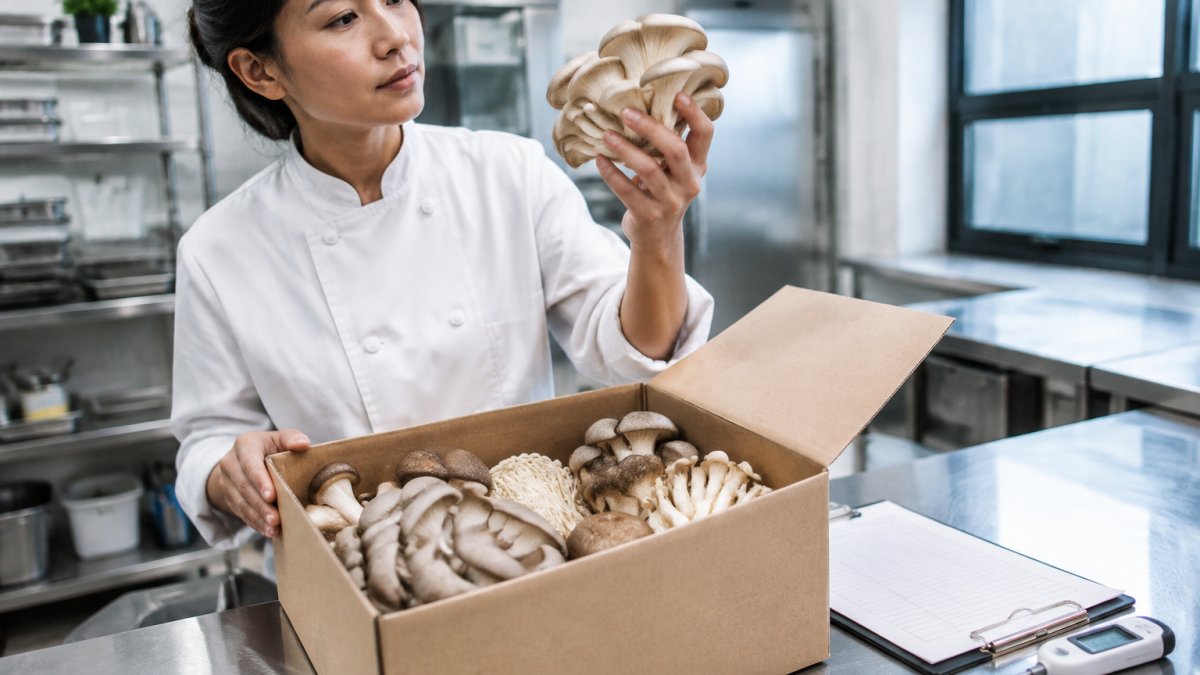
For dock staff who need sharper visual cues, this guide on how to identify fresh oyster mushrooms shows exactly what a good cap and stem should look like.
Watch out: signing off a delivery without probing temperature is the most common receiving mistake. A warm case that looks fine will often fail by the next service.
Fresh Mushroom Storage for Restaurants: Cold Chain and Inventory
Good fresh mushroom storage for restaurants is a procedure, not a slogan. It connects upstream handling to what your prep team does at the walk-in door, on the shelf, and on the line. Mushrooms are mostly water with no protective skin, so every storage decision either buys shelf life or spends it.
Set the Cold Standard Before You Receive
Decide your cold standard in writing and post it where receiving and prep staff can see it. Most operators hold fresh mushrooms in a narrow cold band and check the walk-in daily with a calibrated probe, logging the reading. Steady cold beats cold that swings.
Fresh Mixed Gourmet Mushrooms – Chef Variety Pack →
- Probe the walk-in at the same time each day and record the reading.
- Keep a backup thermometer so a failed probe does not stop the log.
- Put mushrooms away from the door, away from the compressor draft, and off the floor.
Refrigeration Layout and Humidity
Mushrooms need cool air that moves and moderate humidity, not a wet box. Sealed plastic can trap respired moisture, so breathable packaging helps moisture escape.
A practical layout:
- Designate a mushroom shelf or section so staff are not hunting for product during service.
- Keep cases in breathable packaging; if a supplier ships in sealed film, open or vent it on receipt.
- Do not stack heavy cases on mushrooms; crush damage shows up as brown blotches two days later.
Watch out: washing mushrooms before storage is the most common self-inflicted wound. Water on the surface accelerates breakdown. Clean at prep, not at put-away.
Stock Rotation That Actually Happens
First in, first out only works if the shelf makes it easy. Label every case with the receipt date and variety, and load new product behind old. If your team has to dig for the older case, they will grab the newer one and the old case becomes shrink.
- Date every case at receiving, not at put-away.
- Rotate the shelf when you load it, not when you notice a problem.
- Walk the mushroom shelf daily and pull anything softening for same-day use.
Par Levels and Shrink Control
Build a par level by variety based on actual menu usage, not habit. Track usage weekly against what you ordered and threw away. If a variety consistently spoils before use, your par level is too high, not your supplier.
- Count mushrooms at the start and end of each week.
- Note spoilage by variety, not just total waste.
- Adjust par levels monthly using the spoilage numbers.
Connect Storage to Receiving
Storage quality starts at the door. If a case arrives warm or wet, no amount of careful shelving will recover it. Probe temperature at receipt, reject product that fails your standard, and log the result.
For dock staff who need sharper visual cues, this guide on how to identify fresh oyster mushrooms shows exactly what a good cap and stem should look like.
Mushroom Supply Chain Traceability and Food Safety Compliance
Mushroom supply chain traceability means you can follow a case from the grower to your walk-in and back again, and answer a regulator's or guest's question fast. The restaurant version is a working record system tying a lot number to a delivery, a shelf, and a menu item.
Build a Lot-Level Trail, Not a Pile of Invoices
The unit of traceability is the lot, not the invoice. Every delivery should carry a supplier lot or pack date, captured in your receiving log alongside the temperature reading. That single link lets you go from "which case was this?" to "which supplier and harvest window?" in minutes.
A practical trail:
- Record supplier, lot or pack date, variety, quantity, and temperature at receipt.
- Label the case with the same lot so the shelf matches the log.
- Note which menu items or prep batches used that lot.
The One-Page Recall Drill
Traceability only proves itself when you test it. Once a quarter, pick a lot from your log and walk it backward and forward: which supplier, which delivery, which shelf, which menu items, and was any still in-house?
- Pick a lot at random and trace it to the supplier.
- Trace it forward to the menu items that used it.
- Check whether any product from that lot is still on the shelf.
Watch out: a log that is filled in after service, from memory, is not a traceability record. It is a guess with a date on it.
Food Safety Compliance: What Applies to You
Food safety rules for restaurants are set at the federal, state, and local level, and produce safety expectations continue to tighten. The FDA Food Safety Modernization Act overview explains the produce safety framework that growers and buyers work within. For handling and storage guidance, the USDA Food Safety and Inspection Service resources is a practical reference. The CDC guidance on preventing foodborne illness is worth bookmarking for staff training.
Your job as a buyer is not to interpret the rules for your suppliers. It is to verify that they have current food safety documentation, that their records are available on request, and that your own receiving and storage practices meet the standards your local health authority inspects against.
Supplier Documentation to Keep on File
- Current food safety documentation and any relevant certifications.
- Written product specs by variety and grade.
- Traceability records available on request.
Traceability is not paperwork for its own sake. It is how you answer a question fast when one comes, protecting guests, staff, and the business at once.
Cost and Total Landed Cost for Restaurant Buyers
The sticker price is not your real cost. Landed cost includes the invoice plus freight, spoilage, labor for sorting, and the menu cost of a shorted order.
Compare two cases this way:
- Case A costs less per pound but arrives warm and loses a third of its usable weight.
- Case B costs more per pound but arrives cold and holds for the full menu cycle.
Case B often wins once you count waste. Track spoilage by variety for a month and the math becomes obvious. If ownership pushes back on price, bring the spoilage numbers, not the invoice.
Build Your Mushroom Order With Mushroom Direct
Source close, receive carefully, store cold, and hold suppliers to written specs. That routine protects flavor and margin more than any single purchase decision.
At Mushroom Direct, we harvest in small batches at our Queens farm and get mushrooms to kitchens in a matter of hours, with free next-day delivery on featured boxes. Our chef variety pack includes oyster, chestnut, Lion's Mane, and maitake, and our fresh medley box gives you a rotating mix sized for real prep lists.
Start with a small order this week. Probe it at the door, log it, and see how it holds through service. Then build your standing order around what actually performs.
Frequently Asked Questions
How can restaurants assess the quality of a mushroom supplier?
Ask for the harvest date, not just the delivery date, and check how the product is held between harvest and drop-off. Look at cap condition, stem firmness, and whether the packaging shows condensation. Run a 30-day trial with a scorecard tracking arrival temperature, shelf life, and order accuracy before you commit to a standing account.
What should restaurants look for when receiving fresh mushrooms?
Check four things in the first few minutes: temperature, appearance, smell, and packaging condition. Caps should be dry and intact, stems firm, and there should be no sour or fishy odor. Reject crates with heavy condensation or crushed edges. Record the internal temperature of the delivery and log it against your purchase specification. A receiving checklist signed by the person unloading the truck keeps standards consistent across shifts.
How should restaurants store fresh mushrooms to maintain quality?
Keep fresh mushrooms cold in breathable packaging, never sealed in plastic that traps moisture. Store them away from strong-smelling items and off the floor on a labeled shelf. Do not wash before storage; brush or wipe at prep. Rotate stock first-in, first-out and check daily for sliminess or dark spots.
How can restaurants verify mushroom supply chain traceability?
Ask your supplier for lot-level documentation linking each delivery to a harvest date and growing location. Under FSMA traceability requirements, food businesses must be able to produce records when requested. Request the documentation once during onboarding, then spot-check it quarterly to confirm the process still holds.
The gap between a good mushroom dish and a great one is usually freshness, and freshness is a supply chain decision. Mushroom Direct grows in Queens, harvests in small batches, and delivers fast enough that the postharvest clock barely starts. Explore our chef variety pack and medley boxes, set up a wholesale order, and cook with mushrooms that taste like they were picked this morning.
